
Timothy Chrystal Neil’s Military History
Introduction
In this page I outline what I have discovered about Timothy Chrystal Neil’s military service during the Great War of 1914-18, the campaigns he would have been involved in, the intersection between war and his family life as far as I know it, and his demobilisation and return to civilian life. At the end of this I detail the documentary evidence on which my conclusion are based.
After this outline, I have listed the sources I have used and have also added a more detailed list of the activities of the Royal Inniskilling Fusiliers and their campaigns both in Gallipoli and the Western Front.
Timothy Chrystal Neil Before the War
At the taking of the 1901 Census, Timothy Chrystal Neil was living at 21 Salisbury Street, Gorbals Glasgow ; he was aged 10 and a scholar. I have not found him in the 1911 Census yet but he was presumably a young man growing up in an industrial city that, as war approached, provided large numbers of recruits to the British Army during the First World War. Like many young Scottish men, Timothy ultimately entered military service during the conflict, joining the Royal Inniskilling Fusiliers, an Irish line regiment which drew recruits from across the United Kingdom. By July 1917, Timothy is recorded as a Private, 1st Battalion, Royal Inniskilling Fusiliers, and noted as being on active service at the time of his marriage. This confirms that he was serving with a front‑line infantry battalion of the British Expeditionary Force (BEF) during the most intense period of the war.
Why the Royal Inniskilling Fusiliers?
On the face of it, it may seem odd that he joined an “Irish” regiment but, in fact, it was one of the most natural choices for a Catholic man in Glasgow. Although officially a line regiment of the British Army, the Royal Inniskilling Fusiliers were historically Irish being strongly associated with Ulster Catholics, especially those from County Fermanagh and County Donegal. The regiment was perceived (including by recruiters) as a Catholic-friendly Irish regiment and that mattered a great deal in 1914–1916. This isn’t really the place to go into any detail about Ireland and the Great War, suffice it to say that Ireland was a nation divided by World War I and its own political future. The period saw both Irishmen fighting and dying for Britain (as at the Somme), and secret societies like the Irish Republican Brotherhood seizing the moment to strike for a republic (the Easter Rising of 1916). So, for reasons of religion and nationalism, the choice of regiment was important.
The sectarianism so powerful in Ireland, also manifested itself in important ways in Glasgow. It might seem natural for Timothy to join a Scottish regiment but for many Catholic men in Glasgow, some Scottish regiments were seen as culturally Presbyterian and socially unwelcoming. Also, some of the “Irish” regiments of the British Army, The Royal Irish Rifles and Royal Irish Fusiliers had stronger Protestant/Unionist associations. On the other hand, The Royal Inniskilling Fusiliers were regarded as less sectarian, more Catholic in composition and safer socially for Catholic recruits. The regiment maintained an active recruiting drive in Scotland and, although they deliberately sought out Irish Catholic men, many recruits were not Irish at all and did not need to be. Additionally, the regiment recruited heavily in Glasgow and Lanarkshire, Ayrshire and the West of Scotland industrial towns
Of course, TImothy was born in Glasgow so was not Irish himself and neither were his parents but he still had some Irish connections – his grandmother was born in Ireland and two of his three older sisters married Irishmen; his own middle name, Chrystal, came from his mother’s maiden name, her parents both being Irish. No doubt, also, many of his friends and workmates would either be Irish or of Irish descent. A young Catholic man’s desire for identity, belonging and respect could be well met with this choice of regiment; the Inniskillings were already heavily engaged (Gallipoli), prestigious and perceived as a “fighting regiment”. Despite not being Irish himself, for a Catholic Glaswegian, the choice of The Royal Inniskilling Fusiliers was a sensible choice. In fact, more likely rather than unlikely.
Timothy’s Military Service Record
A service record for Timothy would answer a lot of questions about his life during the war but I have not been able to find a service record for him. This is not unusual; approximately 60% of British Army service records from the First World War were destroyed during German bombing in the Second World War, when the War Office repository at Arnside Street, London, was hit during the Blitz in 1940. The remaining records are often referred to as the “burnt documents.”
Soldiers of Timothy’s type — rank-and-file infantrymen without gallantry awards or long pre-war service — are disproportionately represented among the missing files. In such cases, family historians must reconstruct service using secondary evidence such as regimental numbers, medal entitlement, marriage records, hospital admissions, war diaries, and battalion histories. What follows utilises all of these sources.
When Did Timothy Enlist?
I do not know when Timothy joined the army. I have not found him in the 1911 Census, when he would have been about eighteen years old. Timothy’s absence from the 1911 Census is shared with his brother John and sister Elizabeth. His older siblings had married by then and had established households of their own, while the youngest children, Susan and Charles, were living with their parents at 6 Eglinton Lane, Gorbals, Glasgow as boarders in the household of Alex Kemp, a blacksmith.
I have no documentary record of him between the 1901 Census, where he appears as an eight-year-old scholar living at 21 Salisbury Street, Glasgow, and his marriage sixteen years later in 1917, when he is recorded as a coal salesman and a Private in the 1st Battalion, Royal Inniskilling Fusiliers on active service; either have I been able to find attestation papers for him. In the absence of surviving service papers, Timothy’s route into the army cannot be stated with certainty. However, several plausible possibilities exist.
Possibilities
Before 1916, the British Army relied entirely on voluntary enlistment, with particularly large numbers joining in 1914 and 1915 following the outbreak of war. In January 1916, compulsory service was introduced for single men aged 18 – 41, and in May 1916 this was extended to include married men. These measures marked Britain’s transition to a full “total war” footing.
Timothy, born in January 1893, was 21 years old at the outbreak of war and therefore eligible to enlist voluntarily from the beginning of the conflict. He may have enlisted as a volunteer in 1914 or 1915, or he may have entered the army following the introduction of conscription in 1916. Alternatively, he may have been posted to the 1st Royal Inniskilling Fusiliers as a reinforcement draft, a common practice as battalions were rebuilt after heavy losses. So, which of these is the most likely from the scant evidence we have.
Evidence from Regimental Number
Timothy’s regimental number with the 1st Royal Inniskilling Fusiliers was 10241. British Army number blocks were issued roughly in order, and numbers in this range typically belong to men who enlisted during the early years of the First World War, often in late 1914 through 1915. This strongly suggests that Timothy volunteered relatively early in the war, rather than being posted only after the introduction of conscription in 1916.
If he enlisted in 1914/15 he would initially have been posted to a Depot Battalion or a Reserve / Training Battalion. Only after that would he have been drafted into a fighting battalion. So it is unlikely that he was with the 1st Battalion of the Royal Inniskilling Fusiliers when they fought during the Gallipoli Campaign of 1915. Many men who did enlist during this time did not actually reach active service until after the Gallipoli Campaign so without documentary evidence his presence at Gallipoli is unlikely.
Evidence from Service Medal Card
Some evidence comes from his medal card which says that he was awarded the British War Medal and the Victory medal. It does not list the 1914 Star or the 1914-15 Star which was only given to soldiers who had entered a theatre of war before 31 Dec 1915. Therefore it is likely that he enlisted in late 1914 or 1915 and, after training, was posted to 1st Battalion, Royal Inniskilling Fusiliers on the Western Front during 1916.
Conclusion
The 1st Battalion, Royal Inniskilling Fusiliers served throughout the war with the 29th Division, one of the British Army’s most heavily committed formations. Before Timothy’s arrival, the battalion had seen action at Gallipoli in 1915 and was already hardened by heavy fighting and accustomed to high casualty rates. At the end of the campaign, in December 1915, the regiment was evacuated from the peninsula. After a short period in Egypt, defending the Suez Canal, the battalion was transferred to the Western Front. It would seem likely that this was when Timothy joined them as part of battalion reinforcements. The regimental diaries for the Royal Inniskilling Fusiliers can give us a clear picture of what actions Timothy would have been involved in.
1st Battalion, Royal Inniskilling Fusiliers on the Western Front
Service on the Somme and Ancre, 1916–early 1917
During 1916, the 1st Battalion fought on the Somme, including the Battle of Albert (1 July 1916) and later engagements around Guillemont and Ginchy in August and September. By the winter of 1916–1917, the battalion was holding trenches in the Somme / Ancre sector, north of the River Ancre near Beaumont‑Hamel.
Timothy’s early service would have consisted of the routine but dangerous life of a front‑line infantryman: long periods in waterlogged trenches, night patrols, wiring parties, trench raids, and constant exposure to artillery fire. The winter was particularly harsh, with snow, frostbite, and illness compounding the strain of active operations.
The German Withdrawal and Arras, spring 1917
In February–March 1917, German forces began a strategic withdrawal to the Hindenburg Line. The 1st Inniskillings advanced cautiously into abandoned enemy positions, clearing trenches, dealing with booby traps, and suffering casualties from rearguard actions. This phase of the war was dangerous and unpredictable, as the enemy deliberately left mines and delayed‑action explosives behind.
In April and May 1917, the battalion took part in the Battle of Arras, including costly fighting around Oppy Wood, a strongly defended German position. Losses were heavy, and the battalion required rebuilding once again.
Rest, Leave, and Marriage, summer 1917
By June 1917, the 1st Battalion was withdrawn to reserve areas in Flanders for rest, reorganisation, and the absorption of reinforcement drafts. The battalion was billeted in camps and villages including Proven, Herzenberg Camp, and Elverdinghe. Training resumed, but enemy contact was limited.
This period coincided with one of the rare occasions in 1917 when leave was granted on a significant scale. During this lull, Timothy Chrystal Neil returned to Glasgow, where on 16 July 1917 he married at St John’s Church, Portugal Street. The battalion war diary records this as a notably quiet period, with routine duties and church parades rather than combat.
The day after Timothy married, the first men on leave were returning to their units so, within days, Timothy would have had to return. On the 18th July the battalion made night movements to Herzenberg / canal-bank camps. Artillery activity increased daily and the final rehearsals for a large scale offensive were conducted.
Passchendaele, July–November 1917
From mid‑July 1917, the battalion undertook intensive preparation for the forthcoming offensive in the Ypres Salient, including open‑warfare training, practice assaults, and night movements to forward assembly areas. By late July, the battalion moved into positions east of the Ypres–Pilckem Road.
The Third Battle of Ypres (Passchendaele) began on 31 July 1917. Conditions rapidly deteriorated as heavy rain turned the battlefield into deep mud. The 1st Inniskillings fought in the Pilckem–Steenbeek sector and during the Battle of Langemark in August. Infantry advances were conducted through flooded shell holes under machine‑gun fire, and casualties were severe.
The “Third Battle of Ypres” – Passchendaele – was one of the most costly campaigns of the conflict. The battle took place on the Western Front, from July to November 1917, for control of the ridges south and east of the Belgian city of Ypres in West Flanders. The casualties of this battle were huge; it is estimated that there were 245,000 casualties of which 70,000 were killed. If enemy casualties are included, there were some 460,000 – 470,000 casualties. Passchendaele has become emblematic of the attritional nature of trench warfare because so many casualties were suffered for comparatively limited territorial gains.
The 29th Division, of which the 1st Royal Inniskilling Fusiliers was a part, endured heavy casualties at Passchendaele typical of front-line British infantry formations in 1917 — numbering in the thousands across the battle as a whole. Though precise published totals by division aren’t always available, surviving war-diary fragments show the 1st Inniskillings taking dozens to several hundred casualties in specific periods of the Passchendaele campaign, reflecting the intense fighting conditions in Flanders.
Possible Sickness Leave Late August / Early September 1917
At this point a question arises pertaining to the birth of Timothy’s first son, John McDonald Neil. He was born on 15 Jun 1918 and so must have been conceived around late August or early September 1917; but wasn’t Timothy with his battalion on the Western Front at this time?
If we discount the idea that Timothy wasn’t John’s father – a suggestion that we have no evidence at all for and which we have documentary evidence to to the contrary of in John’s civil birth registration, his baptismal register entry and the 1921 Census, then we have to explain how he could have been back in Glasgow just a few months after his marriage. This timing falls after the opening of the Passchendaele offensive on 31 July 1917. From that point onward, leave for front-line infantry units was severely restricted and, in many cases, suspended altogether. It would have been highly unusual for an infantry private to receive a second period of formal home leave within six to eight weeks of his marriage, particularly while his battalion was heavily engaged in sustained offensive operations.
For this reason, it is unlikely that the conception of Timothy’s first child resulted from a second grant of ordinary leave. Instead, the most defensible explanation is that Timothy was temporarily removed from front-line duty for medical reasons in late summer 1917. British Army practice during prolonged fighting frequently saw soldiers evacuated sick for conditions such as exhaustion, trench fever, gastrointestinal illness, or early manifestations of venereal disease. Such removals did not constitute leave but could involve transfer through rear areas or, in some cases, through medical facilities in the United Kingdom. During these periods, men sometimes had brief opportunities to visit family.
Another possibility I considered was that he remained in Glasgow for medical reasons until late August or early September then returned to the front mid-September. After a lot of consideration, I did not think this a very convincing scenario.
In order to try to resolve this I entered into a long exchange with ChatGPT. When I pointed out several contradictions in the whole situation, the LLM tried to resolve it the following way.
After he was married in July 1917, he returned to his regiment and was involved in the action at Passchendaele. At some stage he is removed from front-line duty due to a number of possible reasons including exhaustion, trench fever, diarrhoea, influenza or “debility”. This happened constantly so would not be unusual. He could have been evacuated sick. He may have been returned to the UK enabling him to conceive his first child with Margaret around late August or early September. He may then have returned to the Front later in 1917 to resume his soldiering with his regiment. The truth is, if we accept that Timothy was John’s father – and we have no reason to believe he wasn’t except this one ambiguity – then we might just have to accept that the documentary evidence to support this theory does not exist anymore and that the evidence we do have are just fragments that illuminate little corners of his service life.
There is also another medical possibility but, again, this is difficult to prove before February of 1918 but Timothy did suffer recurring bouts of gonorrhoea and we have documentary evidence of this on two occasions.
If Timothy had returned to the Front soon after his marriage he would have seen further action with his regiment.
The Western Front September – November 1917
The battalion went on to take part in the fighting associated with Polygon Wood (26 Sep 1917), Zonnebeke, Broodseinde (4 Oct 1917), and Passchendaele Ridge (31 Jul – 10 Nov 1917). By the end of the campaign in November 1917, the battalion was badly reduced, suffering from exhaustion, high numbers of casualties, and the effects of prolonged exposure to mud and artillery bombardment.
After Ypres and illness, late 1917–1918
Following Passchendaele, the battalion was withdrawn to the comparatively quieter Cambrai / Bapaume sector, where it undertook trench‑holding and patrol duties while absorbing new drafts of reinforcements. Conditions remained harsh, and sickness was common.
At some point during this period, Timothy contracted gonorrhoea, (see below for more details) a condition widespread among armies during the war. A surviving medical record shows that on 7 February 1918 he was transferred within the BEF medical system, involving No. 34 General Hospital at Le Havre, No. 5 Ambulance Train, and No. 34 Casualty Clearing Station. Le Havre was a major centre for the treatment of venereal disease, where soldiers were treated in segregated wards before being returned to duty if fit.
1918 The German Spring Offensive and Birth of Timothy’s 1st Child
In March 1918, the battalion faced the German Spring Offensive (Operation Michael), which began on 21 March. The 1st Inniskillings took part in defensive fighting and withdrawals under intense pressure. Back hone, on 15 June 1918 Timothy’s wife, Margaret, gave birth to their first child, John McDonald Neil (my father). He was born at 1 South Stirling Street, Gorbals, Glasgow which was almost certainly the home of Margaret’s parents, John and Susan McDonald. At the taking of the 1921 Census the household at 1 South Stirling Street contained Margaret’s mother, father, husband and son. So this is probably where the McDonalds lived throughout the war.
1918 Offensives and Final Evacuation
Returning to the Front, from August 1918, the battalion participated in the Allied Hundred Days Offensive, including the Battle of Albert (August 1918) and the Battle of Cambrai (8–10 October 1918) and Timothy battalion was involved in the final advance of the war. Warfare became increasingly mobile as the Allies advanced through devastated countryside.
Timothy suffered a recurrence of gonorrhoea in the final weeks of the war. On 29 October 1918, he was evacuated from Grévillers, a forward area east of Bapaume, travelling on Ambulance Train No. 31 to Étaples, one of the largest British base medical complexes. His condition rendered him temporarily unfit for duty, and he was removed from the operational zone.
Because the Armistice was signed on 11 November 1918, it is highly likely that Timothy remained hospitalised through the end of the war and did not rejoin his battalion. Many men in hospital at this time passed through demobilisation via the medical system, rather than returning to their units.
End of War and Demobilisation
In 1919, the 1st Battalion, Royal Inniskilling Fusiliers served in Germany as part of the Army of Occupation, before returning to the United Kingdom later that year. But the question still remains what happened with Timothy after his hospitalisation less than two weeks before the Armistice.
The likely course of events was that he was evacuated sick on 29 October 1918 and taken to the base hospital at Étaples where he was diagnosed with gonorrhoea, classed as “temporarily unfit” and retained under treatment through and beyond Armistice. VD patients were explicitly excluded from immediate demobilisation until their treatment was completed, they were certified as non-infectious and they were cleared by a medical board. This often delayed their release by weeks or months.
From this we can speculate with some confidence that he did not return to his battalion after October 1918 so was not part of the Army of Occupation in Germany. His war ended in hospital but he was still legally a soldier until 1919. The birth of his second child, Mary Ann Chrystal Neil, on 24 November 1919 indicates a conception in approximately late February or early March 1919. It is therefore highly likely that Timothy spent November and December of 1918 under hospital treatment before undergoing medical clearance and demobilisation during January or February 1919 before returned to civilian life in February 1919, shortly before the conception of his second child in late February or early March 1919.
Timeline of Service and Family
|
Late 1914–1915 |
Voluntary enlistment (Reg. No. 10241) |
|
1916 |
Enters overseas service, France |
|
Jul 1917 |
Home leave |
|
16 Jul 1917 |
Marriage in Glasgow |
|
Aug–Sep 1917 |
Passchendaele fighting |
|
Likely delayed leave / evacuation | |
|
Conception of first child | |
|
15 Jun 1918 |
Birth of first child – John McDonald Neil – 15 Jun 1918 |
|
Feb 1918 |
Hospitalised for gonorrhoea |
|
Mar–Oct 1918 |
Spring Offensive and Hundred Days |
|
29 Oct 1918 |
Evacuated sick from Grévillers to Étaples |
|
11 Nov 1918 |
Armistice (Timothy still hospitalised) |
|
Feb 1919 |
Likely demobilisation and return home |
|
Late Feb–Mar 1919 |
Conception of second child |
|
24 Nov 1919 |
Birth of second child – Mary Ann Chrystal Neil – 25 Nov 1919 |
Medal Card
In common with millions of other veterans, Timothy Chrystal Neil was awarded the British War Medal and the Victory Medal, recognising his active service overseas during the First World War. As we have seen above, he did not receive awards given to soldiers who saw action before the end of 1915 and this has given us some information to support our tentative conclusion that he did not enter active duty until 1916. There are two sources for this; the first is his medal card avaialble at FindMyPast.co.uk
![1918 Campaign Medal Car Timothy Chrystal Neil [[N142-clip]]](https://family.billneil.org/wp-content/uploads/2025/12/N142_clip.jpg)
Timothy Chrystal Neil Medal Card 1914-18 War: FindMyPast “Britain, First World War Campaign Medals, The National Archives Record Set Britain, First World War Campaign Medals. Archive Ref WO 329/1130, Record ID GBM/WO329/WWI/CM/4301756”.
And the second his listing on the Medal Roll for the regiment available at Ancestry.co.uk
![1918 WW1 Medal Roll Page Timothy Chrystal Neil [[N143-clip]]](https://family.billneil.org/wp-content/uploads/2025/12/N143-clip.jpg)
Timothy Chrystal Neil Medal Roll 1914-18 War: Ancestry.com “The National Archives of the UK; Kew, Surrey, England; War Office and Air Ministry: Service Medal and Award Rolls, First World War. WO329, Piece 1130: Royal Inniskilling Fusiliers, Ref: 1130 Image 290.”
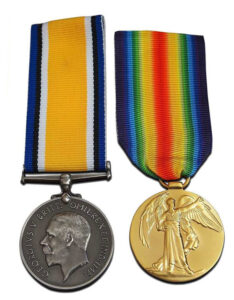
Stock image of the medals that Timothy Chrystal Neil was awarded – not the original medals
The only other direct sources we have are to do with his medical conditions.
Medical Records
The evidence for Timothy’s outbreak/s of gonorrhoea come from two document. The first one is dated 7th February 1918 and it reads “10241 Pte. Neil, T.C. 1/R. Inn. Fus. VDG……Trans to 34 CSS .per 5 AT .ex 34 Gen . H . Havre 7 Feb. 1918.
![1918-02-07 WW1 Medical and Sick Record Timothy Chrystal Neil [[N149-clip]]](https://family.billneil.org/wp-content/uploads/2025/12/N149-clip.jpg)
Timothy Chrystal Neil Medical Record: FindMyPast.co.uk “British Army Service Records, Wo 363 – First World War Service Records ‘Burnt Documents, Series WO 363, 1914-20, Servie No 10241. Record ID GBM/WO363-4/SUPP/416822”
My understanding of this document is that it records Timothy being returned to his battalion from No. 34 General Hospital at Le Havre after treatment for gonorrhoea. Number 5 Ambulance Train takes him to No. 34 Casualty Clearing Station which would have been a site a few miles behind the front lines where train links allowed for the movement of soldiers. Le Havre was a major VD treatment hub. In 1916–1918, men with gonorrhoea were removed from front-line units, treated in segregated wards and sometimes transferred between hospitals during treatment. They were usually returned to duty unless complications arose. Many men treated for VD, but not all, returned to front-line duty within weeks.
The other document I have shows Timothy being moved by train again.
![1918-09-29 WW1 Medical and Sick Record Timothy Chrystal Neil [[N149b-clip]]](https://family.billneil.org/wp-content/uploads/2025/12/N149b-clip.jpg)
Timothy Chrystal Neil Medical Record: FindMyPast.co.uk “British Armed Forces, First World War Soldiers’ Medical Records 20 Oct 1918 to 02 Nov 1918, British Expeditionary Force to France, other ranks, Hospital admission and discharge registers. Archive reference MH 106/2008. Hospital
31st Ambulance Train Service number 10241 29 OCT 1918″
This document records Timothy being transferred aboard Ambulance Train No 31 on 29 October 1918; he entrained at Grévillers and detrained at Étaples. By late October 1918 the 1st Royal Inniskilling Fusiliers were advancing as part of the Hundred Days Offensive in the final advance of the war. Timothy was likely diagnosed with gonorrhoea at a Regimental Aid Post or CCS, classified as unfit for duty and marked for evacuation out of the operational zone. Grévillers was a forward area, east of Bapaume, very close to the front during the final Allied advance that was used as a collection point for wounded and sick men. From here Ambulance Trains like No. 31 were used to move men from forward CCS areas to base hospitals, to transport non-walking wounded and sick and to carry men who were ill, exhausted, or temporarily unfit. The fact he went by train (not walking or lorry) suggests that he was not fit to march but also not in immediate danger. Men were still being wounded, sickened, and evacuated right up to 11 November 1918; there was no slowing of medical evacuation until the Armistice actually happened.
Étaples was one of the largest British medical base complexes of the war – not a hospital itself, but a massive medical base area. By late 1918, the British Army had very strict VD control policies, especially for men at the front. VD cases were not allowed to remain with fighting units. Gonorrhoea was considered contagious and a drain on manpower; once diagnosed, men were immediately evacuated out of the line and, even in the final weeks of the war, VD policy did not relax.
Timothy’s infection might have been as a result of a recurrence or complication of the earlier February 1918 infection. After detraining at Étaples, he would have been admitted to a General or VD hospital and held there for weeks, possibly into December 1918. Since Armistice day was 11th November 1918, he might still have been in hospital at the end of the war and may have had to stay there until the end of December. Men already in hospital often stayed there through the Armistice and never returned to their battalions so it is very likely that he never rejoined the 1st Inniskilling Fusiliers after 29 October 1918. Furthermore, He may have gone through demobilisation via the medical system, not via his battalion.
Gonorrhoea took between 6 – 12 weeks to treat. Chronic or relapsing cases could take 2 – 6 months. There were no antibiotics so treatment involved isolation in VD wards, daily painful urethral irrigations with Potassium permanganate and Protargol (silver compound). Strict bed rest was enforced and repeated smears had to be taken. Alcoho; was not allowed and there was no chance of leave. The treatment was slow, uncomfortable, and uncertain. I outlined above how the move from front line to hospital to demobilisation and then back to home might have worked out for Timothy
You can read much more about venereal diseases during WW1 here and here
Sources
- Findmypast — Soldiers’ medical records (hospital admission/discharge collections). Findmypast
- Ancestry — UK, WWI Hospital Registers, 1915–1919. Ancestry
- The National Archives — research guide & MH106 (representative medical records). The National Archives
- The Long, Long Trail — overview of hospital admission/discharge records and where to look. The Long, Long Trail
- Forces War Records — collection of Military Hospitals admissions & discharge registers (paywalled).
- The Western Front Association- The Western Front Organisation
- Chat GPT
- Wikipedia
Background to WW1 and 1st Battalion Royal Inniskilling Fusiliers
Background to WW1
Since 1815 the balance of power in Europe had been maintained by a series of treaties. In 1888 Wilhelm II was crowned ‘German Emperor and King of Prussia’ and moved from a policy of maintaining the status quo to a more aggressive position. He did not renew a treaty with Russia, aligned Germany with the declining Austro-Hungarian Empire and started to build a Navy to rival that of Britain. These actions greatly concerned Germany’s neighbours, who quickly forged new treaties and alliances in the event of war. On 28th June 1914 Franz Ferdinand the heir to the Austro-Hungarian throne was assassinated by the Bosnian-Serb nationalist group Young Bosnia who wanted pan-Serbian independence. Franz Joseph, the Austro-Hungarian Emperor (with the backing of Germany) responded aggressively, presenting Serbia with an intentionally unacceptable ultimatum, to provoke Serbia into war. Serbia agreed to 8 of the 10 terms and on the 28th July 1914 the Austro-Hungarian Empire declared war on Serbia, producing a cascade effect across Europe. Russia bound by treaty to Serbia declared war with Austro-Hungary, Germany declared war with Russia and France declared war with Germany. Germany’s army crossed into neutral Belgium in order to reach Paris, forcing Britain to declare war with Germany (due to the Treaty of London (1839) whereby Britain agreed to defend Belgium in the event of invasion). By the 4th August 1914 Britain and much of Europe were pulled into a war which would last 1,566 days, cost 8,528,831 lives and 28,938,073 casualties or missing on both sides.
Structure of the British Army
During the First World War, there were four distinct British armies. The first comprised approximately 247,000 soldiers of the regular army, over half of whom were posted overseas to garrison the British Empire, supported by some 210,000 reserves and a potential 60,000 additional reserves. This component formed the backbone of the British Expeditionary Force (BEF), which was formed for service in France and became known as the Old Contemptibles. The second army was provided by the approximately 246,000-strong Territorial Force, initially allocated to home defence but used to reinforce the BEF after the regular army suffered heavy losses in the opening battles of the war. The third army was Kitchener’s Army, which was composed of men who answered Lord Kitchener’s call for volunteers in 1914–1915 and went into action at the Battle of the Somme in 1916. The fourth army was the reinforcement of existing formations with conscripts after the introduction of compulsory service in January 1916.
By the end of 1918, the British Army had reached its maximum strength of 3,820,000 men and could field over 70 divisions. The vast majority of the British Army fought in the main theatre of war on the Western Front in France and Belgium against the German Empire. Some units were engaged in Italy and Salonika against Austria-Hungary and the Bulgarian Army, while other units fought in the Middle East, Africa and Mesopotamia, mainly against the Ottoman Empire, and one battalion fought alongside the Japanese Army in China during the Siege of Tsingtao.
See Wikipedia
The Royal Inniskilling Fusiliers – Pre 1914
The Royal Inniskilling Fusiliers was an infantry regiment that served through the First World War with multiple battalions on the Western Front, Gallipoli, Egypt and elsewhere. It formed part of the 87th Infantry Brigade, one of the three Brigades in the 29th Division. It consisted of four battalions drawn from garrisons in China, India and Burma. They sailed to England in early 1915 and consolidated near Rugby. The battalions were the 2nd Battalion South Wales Borderers – Tientsin, China, 1st Battalion King’s Own Scottish Borderers – Lucknow, India, 1st Battalion Royal Inniskilling Fusiliers – Trimulgherry, India and the 1st Battalion Border Regiment – Maymyo, Burma.
The Royal Inniskilling Fusiliers Prepare For War
At the outbreak of war in August 1914 The Royal Inniskilling Fusiliers were ordered back to the UK as part of the 29th Division and by January 1915 they were in England preparing at Rugby between 18 Jan 1915 and departing 16 March 1915, sailing to Malta then Alexandria in Egypt and arriving on Lemnos on 24 April 1915. The detailed War Diaries kept by the British Army are invaluable records of the time and are held at the National Archive. They are available there online and at Ancestry.com. There are also some reproductions in both eBook and printed book form.
The Royal Inniskilling Fusiliers – The Gallipoli Campaign (1915-1916) – Overview
The next day the Royal Inniskilling Fusiliers were part of the landing force at X Beach, Gallipoli along with the 1st Battalion of the Border Regiment. By mid-October 1915 the 87th Brigade, nominally 4,200 men would be reduced to less than 700 men. Only nine out of every ten men of the original 1st Bn Royal Inniskilling Fusiliers would answer the roll call in just six months fighting at Gallipoli.
The Introduction to the eBook “Gallipoli Diaries 1915-1916 of the 1st Battalion of the Royal Inniskilling Fusiliers, part of the 87th Infantry Brigade of the 29th Division” says
“The Gallipoli campaign remains one of the most controversial campaigns of the Great War. Modern academics and historians are largely split on the chances of success. The ‘Easterners’ believe it could have worked, knocking the Ottoman Empire out of the war and enabling the opening up of supply routes to Russia. The ‘Westerners’ believe it was doomed from the start and never stood a chance of success; the war could only be decided on the Western Front. The latter group has grown in number in recent years however the campaign still generates heated debate among academics.”“
It continues:
“In May 1915 the (29th) Division moved to Lemnos, an island close to the Gallipoli peninsula in preparation for the amphibious landings in April 1915. The Battalion would stay in theatre for eight months and took part in some of the most brutal fighting on the peninsula. Fighting at Gallipoli was a fairly unique experience. With their backs to the sea the British forces were rarely out of danger. Most of the ‘rest areas’ were within the range of the Ottoman artillery and were constantly under threat. Artillery and artillery ammunition was in short supply on both sides, so the campaign did not experience the scale of bombardments seen on the Western Front. Despite this, danger came in many other forms. The physical conditions were extreme. The masses of decaying corpses at the height of the Mediterranean summer became breeding grounds for plagues of flies. Few truces were arranged to bury bodies and the flies spread disease rapidly. Dysentery afflicted most men at some stage. Non-battle casualties were horrendous. During the height of the summer the Battalion fought the bitter battles of Krithia on Cape Helles in squalid conditions. In August 1915, after the stuttering progress of the New Army Divisions at the landings at Suvla Bay, the 87th Infantry Brigade along with the 86th Infantry Brigade was sent to Suvla to stiffen the ranks. The battalion consequently took part in what was to be the largest offensive made during the whole campaign in the Battle of Scimitar Hill on 21st August 1915. The 1st Bn Royal Inniskilling Fusiliers took a central role in the attack and suffered heavy casualties. Of the 744 All Ranks who started that day only 288 would remain unscathed. Casualties exceeded 60%. The attack was a failure and proved be the last mass offensive action of the whole campaign. Three weeks later, on 10th Oct 1915 the Brigade took stock of its casualties to date and counted the number of the original cohort who had landed on 25th April some six months earlier. Only 109 of the 1,028 ‘originals’ of the 1st Bn Royal Inniskilling Fusiliers answered the roll call that day. Most had at one stage been wounded or sick and evacuated, only later recover and return to the peninsula. Only 64 of the original battalion had never left Gallipoli.““
The Royal Inniskilling Fusiliers – The Gallipoli Campaign (1915-1916) – Details of Actions
The War on the Western Front (1916-18)
Location of the 1914-1918 Battlefields of the Western Front from The Great War web site
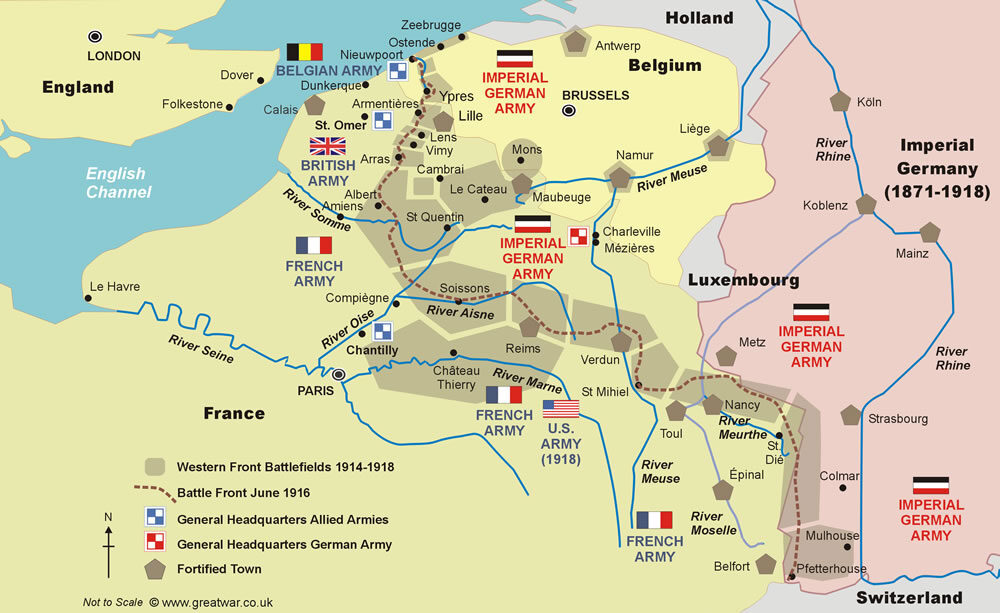
This map illustrates the battlefield sectors of the 1914-1918 Western Front. The line of battlefields ran through a wide variety of landscapes from its northern end in the dunes of the West Flanders Belgian coast to the frontier crossing at the village of Pfetterhouse on the Swiss-German (Alsace) border. The Franco-German border east of Belfort and St. Dié is shown on this map as it was in 1914 when war broke out. Clicking on the link above or the map itself takes you to the online, interactive version of the map where you can click on a shaded area for the location of the battle sector and a brief comment. “Some of the battle sectors are expanded with detailed information pages about the battles fought there, listings of cemeteries, memorials, museums, battle sites, events and visitors’ information.”